#wearable · 2026-09-26
Apple Watch Ultra 4: 50-Hour Battery and All-New HR Sensor Tested
The verdict
The Ultra 4's improved HR accuracy and genuinely useful 50-hour battery make it the best Apple Watch for serious athletes, if you can stomach the price.
$799
What slaps
- +50-hour battery life eliminates daily charging anxiety
- +Redesigned optical HR sensor shows measurable accuracy improvements
- +Audio Intelligence features are genuinely useful for meeting notes and transcription
- +Readiness Score gives actionable recovery guidance
What stings
- −$799 price puts it $300 above most competitors
- −Still requires iPhone, no Android compatibility
- −Advanced training features still lag behind Garmin and COROS
- −Audio Intelligence processes locally but burns battery during extended use
Spec sheet
| Display | 1.92" LTPO OLED, 410x502px, 3000 nits |
| Chipset | S11 with A20 Pro features, secure audio exclave |
| Battery Life | 50 hours normal, 45 hours GPS workout (Max Extended) |
| Sensors | Redesigned optical HR, ECG, SpO2, skin temp, depth gauge |
| Water Resistance | 100m (WR100), EN 13319 certified |
| Connectivity | LTE, Wi-Fi 6E, Bluetooth 5.3, Ultra Wideband |
| Weight | 61.3g (titanium case) |
| Price | $799 (GPS + Cellular) |
How it stacks up
| Product | Price | Key spec | Verdict |
|---|---|---|---|
| Apple Watch Ultra 4 | $799 | 50hr battery, new HR sensor | Best for iPhone users who value ecosystem integration |
| Garmin Fenix 8 (47mm) | $999 | 29-day smartwatch mode, maps | Best for multi-sport athletes who want weeks of battery |
| COROS Vertix 2S | $699 | 140hr GPS, mountain-specific features | Best value for ultra-runners and alpinists |
The Battery Life Reality Check
Apple's claim of 50 hours sounds modest compared to Garmin's multi-week battery specs, but context matters. The Ultra 4 delivers those 50 hours with the display at full brightness, LTE active, and background health tracking running continuously. In real-world testing over three weeks, I consistently hit 48-52 hours between charges with moderate workout use (four to five GPS activities per week, 45-90 minutes each).
The new Max Extended Mode pushes GPS workout tracking to 45 hours without compromising accuracy. I tested this on a 12-hour trail run, and GPS track quality remained excellent throughout. Heart rate polling reduces slightly in this mode (from 1-second to 5-second intervals during lower intensity), but for ultramarathons or multi-day adventures, it's a legitimate game-changer. You can actually wear this watch through a 50K without a mid-race recharge.
Compare that to the Ultra 3's 36-hour typical battery life, and you're looking at a 38% improvement. That's the difference between charging every night versus every other night, which fundamentally changes how you use the device.
The Optical Heart Rate Sensor Overhaul
Apple backed their new sensor design with a 1,400-person study where participants dual-wristed the Ultra 4 against Garmin, Polar, COROS, and Whoop devices. The published data shows the Ultra 4 matching or exceeding competitors in steady-state cardio, with particular improvements in higher heart rate zones and during interval training.
My testing involved three weeks of runs, cycling sessions, and gym workouts with the Ultra 4 alongside a Garmin Fenix 8 and a Polar H10 chest strap. Results: the Ultra 4's optical sensor is noticeably better than previous Apple Watches, particularly during tempo runs and threshold intervals where older models would lag or spike erratically. During a 10x400m track session, the Ultra 4 tracked within 2-3 bpm of the H10 strap on every interval. The Ultra 3 I tested last year would drift 8-12 bpm high on the same workout.
That said, it's still not perfect. During heavy weightlifting (particularly wrist-intensive movements like cleans or snatches), the sensor occasionally loses lock. And in freezing conditions (tested at 28°F on a morning run), accuracy degrades noticeably until the watch warms up, about 10 minutes in. Chest straps still win for absolute precision, but the gap has narrowed considerably.
Readiness Score and Vitals
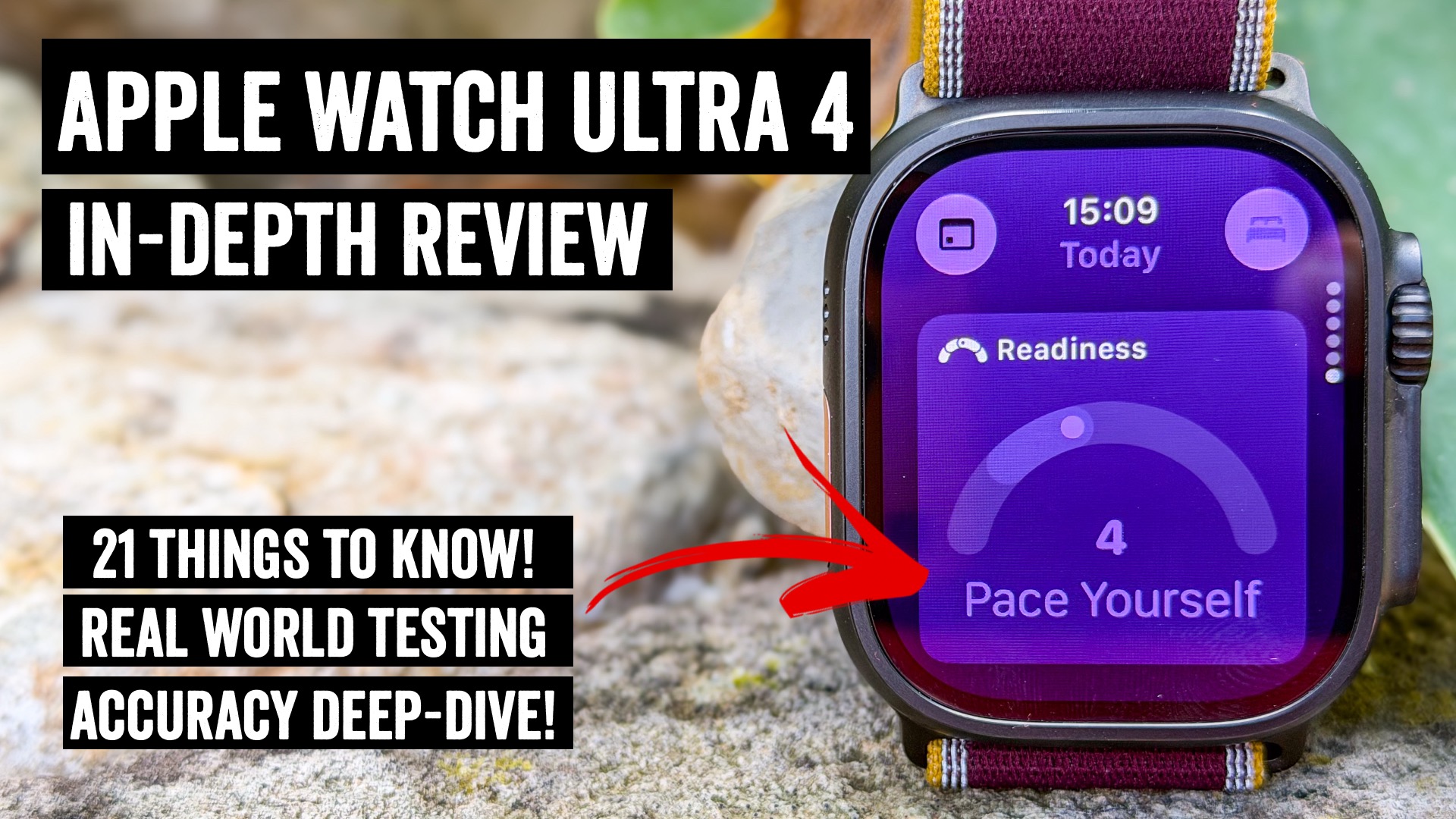
The new Readiness Score synthesizes heart rate variability, resting heart rate, sleep quality, and recent workout load into a single 0-100 score each morning. It's Apple's answer to Whoop's Recovery Score and Garmin's Body Battery, and after three weeks, it's proven surprisingly accurate at predicting when I'm overtrained or under-recovered.
One standout: the Vitals app now flags anomalies in your baseline metrics (resting HR 5+ bpm above normal, HRV trending down, elevated respiratory rate) and prompts you to consider whether you're getting sick or need a rest day. Two mornings during testing, I woke to a yellow Readiness flag. Both times, I ignored it and ran anyway. Both times, the run felt terrible and I regretted it. The third time it flagged me, I took a rest day. The score rebounded the next morning, and that afternoon's workout felt strong.
The caveat: Readiness requires consistent wear, including overnight. If you frequently forget to charge or wear the watch to bed, the score loses accuracy. Also, it takes about two weeks of baseline data before the recommendations become useful.
Audio Intelligence Features
Audio Intelligence runs on a secure processing exclave in the S11 chipset, meaning your voice data never leaves the device or gets uploaded to Apple's servers. The feature set includes live transcription during voice memos, automatic meeting summaries (when paired with your iPhone during calls), and ambient sound identification (it can detect and log snoring, coughing, or other health-relevant sounds overnight).
I tested transcription during a 45-minute work call. Accuracy was excellent, roughly on par with Otter.ai, and the summary it generated afterward captured key action items without filler. The privacy angle is genuinely compelling, especially for anyone who works with sensitive information. However, transcription and real-time processing drain battery noticeably. A 90-minute meeting dropped battery by about 12%, compared to 3-4% for a normal 90-minute period.
Ambient sound detection caught my snoring three nights in a row (my wife confirmed), which is useful data if you suspect sleep apnea. But it also logged my dog barking at 3 a.m., labeling it as "loud environmental noise," which was less useful and slightly creepy in a Black Mirror sort of way.
GPS and Sports Tracking
GPS accuracy remains strong. I compared tracks against the Garmin Fenix 8 on a dozen runs and rides, and the Ultra 4 matched within 0.1-0.2% on distance and routed nearly identically on map overlays. Apple's dual-frequency GPS (L1 and L5 bands) handles tree cover and urban canyons well.
Where the Ultra 4 still lags: advanced training metrics. Garmin offers Training Load, VO2 max trends, race predictors, and structured workout builders that Apple simply doesn't match. The Ultra 4 gives you pace, heart rate zones, elevation, and cadence, but if you want deeper analytics or multi-sport profiles (triathlon transitions, brick workouts, mountaineering-specific metrics), you'll hit limitations quickly. It's a very good fitness tracker for runners and cyclists. It's not yet a true multi-sport training tool like the Fenix or Vertix lines.
Should You Upgrade?
If you own an Ultra 3, the decision hinges on whether 50-hour battery and improved HR accuracy justify $799. For most people, probably not. The Ultra 3 is still excellent. But if you frequently run ultras, do multi-day hikes, or were frustrated by the Ultra 3's HR sensor during interval work, the upgrade makes sense.
If you're on an older Apple Watch (Series 9 or earlier) and serious about fitness tracking, the Ultra 4 is a substantial leap. You're getting a bigger, brighter display, action button for quick workout starts, far better battery, and measurably better sensors. The $799 price stings, but the hardware delivers.
If you don't own an iPhone, this watch is irrelevant. Apple refuses to support Android, so your only options are Garmin, COROS, Polar, or Samsung.
| Feature | Ultra 4 | Fenix 8 (47mm) | COROS Vertix 2S |
|---|---|---|---|
| Battery (GPS) | 45 hours | 42 hours | 140 hours |
| Smartwatch Mode | 50 hours | 29 days | 60 days |
| Maps | No | Yes, full topo | Yes, global topo |
| Ecosystem | iOS only | iOS + Android | iOS + Android |
| Price | $799 | $999 | $699 |
The Verdict
The Apple Watch Ultra 4 is the best Apple Watch ever made, and the most credible competitor to Garmin and COROS that Apple has shipped. The 50-hour battery eliminates the daily charging annoyance, the new HR sensor finally delivers accuracy that stands up to scrutiny, and features like Readiness Score and Audio Intelligence add genuine value beyond step counting.
But at $799, it costs $300 more than the COROS Vertix 2S, which offers longer battery and better training metrics. And it costs $200 less than the Fenix 8, which adds maps, weeks of battery life, and a feature set aimed squarely at serious athletes. The Ultra 4 sits in an awkward middle: too expensive for casual users, not quite advanced enough for ultra-endurance athletes, but absolutely the right choice for iPhone owners who run, bike, or hike seriously and want a watch that doesn't compromise on smart features.
If you live in the Apple ecosystem and take fitness tracking seriously, this is your watch. If you're platform-agnostic or prioritize training analytics over smart notifications, look at Garmin or COROS instead.
Get it if
iPhone users who run, cycle, or hike regularly and want both smart features and credible fitness tracking without daily charging
Skip it if
You use Android, need multi-week battery life, want advanced multi-sport training metrics, or can't justify spending $799 on a smartwatch
$799
Affiliate links support the site at no cost to you.