#smart-home · 2026-11-21
Aqara FP400: 8 Zones of Presence, One Hub Dependency
The verdict
Excellent spatial awareness for Aqara users, but limited standalone utility and headcount inaccuracies prevent a top recommendation.
$79.99
What slaps
- +Granular 0.5m x 0.5m zone detection
- +60GHz mmWave radar for true presence
- +Matter protocol support
What stings
- −Requires Aqara Hub for custom zones
- −Headcount accuracy is +/- 3 people
- −No standalone app functionality
🚩 Before you buy
- !Requires Aqara Hub for custom zones
- !Headcount accuracy is +/- 3 people
Spec sheet
| Sensor Type | 60GHz mmWave Radar |
| Max Zones | 8 Custom Zones |
| Max Targets | 10 People |
| Connectivity | Matter, Zigbee |
| Price | $79.99 |
How it stacks up
| Product | Price | Key spec | Verdict |
|---|---|---|---|
| Aqara FP400 | $80 | 8 Zones | Best for Aqara Ecosystem |
| Aqara FP1 | $40 | Basic Motion | Budget Alternative |
| Shelly Plus 1PM | $15 | Relay Control | Simple Switching |
The Problem with Traditional Motion Sensors
Traditional passive infrared (PIR) motion sensors have a notorious weakness in smart home automation. They detect movement, not presence. If you sit still to read a book, work at a desk, or watch a movie, the sensor eventually assumes the room is empty and turns off the lights. This creates a frustrating user experience where the smart home feels less intelligent and more annoying. The Aqara FP400 Spatial Multi-Sensor aims to solve this specific pain point by introducing high-precision millimeter-wave radar technology to the consumer market.
Spatial Intelligence and Zone Detection
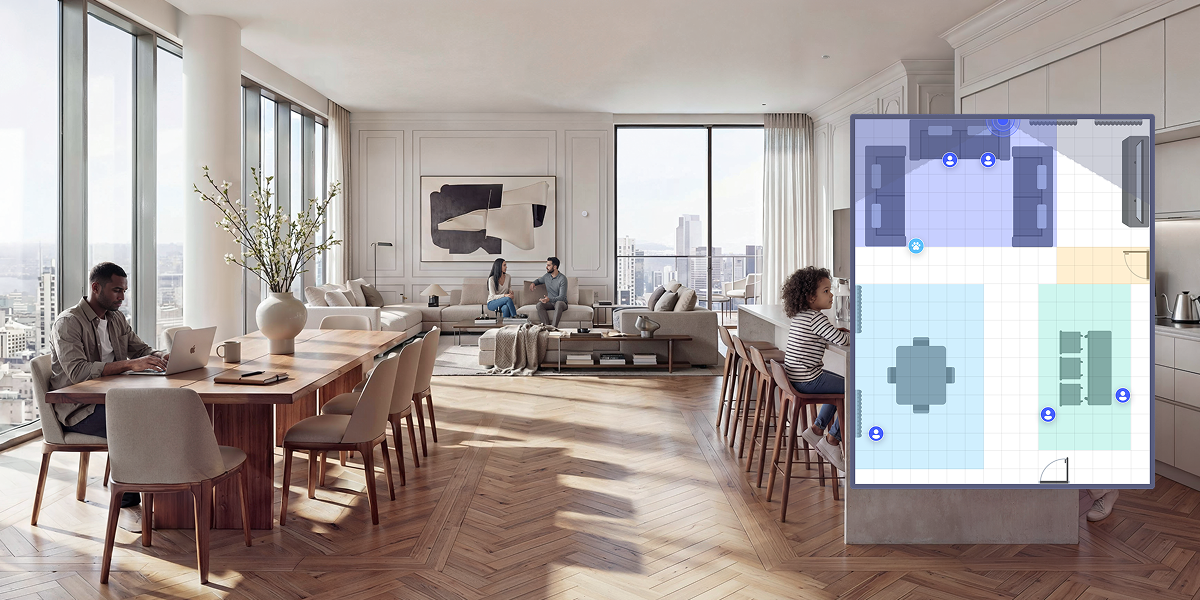
The standout feature of the FP400 is its ability to divide a single room into up to eight customizable zones. Using a high-precision 0.5 meter by 0.5 meter grid, the sensor maps the detection area with granular detail. This allows for sophisticated automations that react to exactly where you are in a room. For example, you can configure the sensor to trigger task lighting when you sit at your desk, while activating softer ambient lighting when you move to the sofa. This level of spatial awareness transforms a single sensor into a multi-purpose device that could previously require several cheaper sensors to achieve.
The FP400 utilizes next-generation 60GHz mmWave radar combined with a 4T4R MIMO antenna array. This hardware configuration provides stronger resistance to interference and more stable performance in real-world home environments compared to older radar technologies. It detects presence without relying on obvious movement, meaning it can tell if you are sitting still or breathing. This is the core value proposition of the device, and in this regard, it delivers on its promise.
Tracking Accuracy and Limitations
Aqara claims the FP400 can track up to 10 people in real-time across multiple zones. However, it is crucial to manage expectations regarding headcount accuracy. The device is not a precision people-counting system. Aqara explicitly warns that the count can be off by one to three people when several individuals are present. Therefore, the headcount should be treated as an estimate rather than an exact tally. The stronger use case remains spatial automation, where the system detects whether someone is in a particular part of the room and responds accordingly, rather than trying to count every individual with mathematical precision.
Ecosystem Lock-in and Matter Support
While the FP400 supports the Matter protocol, there is a significant caveat that limits its flexibility. Custom zone detection is only available when the sensor is set up in the Aqara Home app via an Aqara Hub. Direct connection to a third-party Matter ecosystem without the Aqara Hub does not support custom zones. This means that if you are a pure Matter user with a hub like Home Assistant, Apple Home, or Google Home without an Aqara bridge, you will lose the primary feature that justifies the FP400's higher price point. You will get basic presence detection, but not the spatial intelligence.
This dependency on the Aqara Hub creates a walled garden effect. For users already invested in the Aqara ecosystem, the FP400 is a seamless addition. For those building a multi-brand smart home, the requirement for a specific hub to unlock the full feature set is a notable drawback. The device respects privacy by not using cameras, which is a significant advantage over visual sensors, but the data processing still relies on the Aqara infrastructure for the advanced features.
Design and Installation
The FP400 features a clean, minimalist industrial design that blends well with modern interiors. Installation is straightforward, typically involving mounting the sensor on a ceiling or wall. The 60GHz radar has a wide detection angle, allowing it to cover large living areas effectively. The setup process in the Aqara Home app is intuitive, allowing users to draw zones on a floor plan or define them by coordinates. Once configured, these zones can be exposed to supported third-party platforms, provided the Aqara Hub is in the loop.
Verdict
The Aqara FP400 is a compelling device for users who want to eliminate the 'frozen motion' problem without resorting to camera-based tracking. Its 60GHz mmWave radar provides reliable presence detection, and the eight-zone capability allows for nuanced automations that feel truly intelligent. However, the requirement for an Aqara Hub to access these zones limits its appeal for broader smart home enthusiasts. Additionally, the inaccuracy in headcounting means it should not be relied upon for security or precise occupancy counting. If you are deep in the Aqara ecosystem, this is a must-have upgrade. If you are building a multi-brand setup, you may find better value in simpler, more open solutions.
Get it if
Aqara ecosystem users who want precise presence detection
Skip it if
Pure Matter users without Aqara Hub
$79.99
Affiliate links support the site at no cost to you.