#gadget · 2026-09-03
GPD Win Max 3: 165Hz AMOLED and Ryzen AI Max+ Power in a Handheld

The verdict
Impressive specs and display, but niche appeal, high price, and August 2026 delivery make it a wait-and-see proposition.
$1,199+
What slaps
- +Exceptional 165Hz AMOLED display with HDR10 and 1050 nits peak brightness
- +AMD Ryzen AI Max+ 395 delivers serious gaming performance with 40 CU Radeon 8060S
- +Detachable controllers and convertible laptop mode offer versatility
- +Dual M.2 slots and up to 128GB LPDDR5x-8000 RAM
What stings
- −Won't ship until August 2026, months away with no hands-on reviews yet
- −Price likely $1,200+ based on GPD's history, undercutting value
- −GPD's track record includes QC issues and inconsistent support
- −Heavy and bulky compared to Steam Deck or ROG Ally
🚩 Before you buy
- !August 2026 ship date means nearly a year of waiting with no guarantee of on-time delivery
- !GPD's history includes quality control issues and inconsistent customer support
- !No independent reviews or hands-on testing available yet
- !Estimated $1,200+ price is double the cost of proven alternatives
Spec sheet
| Display | 9.06" 2400×1504 AMOLED, 165Hz, HDR10, 1050 nits peak |
| Processor | AMD Ryzen AI Max+ 395 (16C/32T) or 388 (8C/16T) |
| Graphics | AMD Radeon 8060S (40 CU, 14.82 TFLOPS) |
| RAM | 32GB / 64GB / 128GB LPDDR5x-8000 (quad-channel) |
| Storage | 2× M.2 slots (1× 2280 PCIe 4.0 x4, 1× 2230 PCIe 4.0 x2) |
| TDP | 45W - 110W |
| Battery | Modular battery design (capacity TBA) |
| Weight | TBA (likely 900g+ based on size) |
| Release | August 2026 |
How it stacks up
| Product | Price | Key spec | Verdict |
|---|---|---|---|
| GPD Win Max 3 | $1,199+ | 9.06" 165Hz AMOLED, Ryzen AI Max+ 395 | Wait for reviews |
| Steam Deck OLED | $549 | 7.4" 90Hz OLED, custom AMD APU | Best value |
| ASUS ROG Ally X | $799 | 7" 120Hz IPS, Ryzen Z1 Extreme | Proven alternative |
What GPD Is Promising
The GPD Win Max 3 positions itself as the ultimate handheld gaming PC, combining laptop-grade power with handheld portability. At its core sits AMD's brand-new Ryzen AI Max+ 395 processor, a 16-core Zen 5 chip with 40 compute units of Radeon 8060S graphics. This is the same silicon powering high-end mini PCs, not the cut-down APUs you find in most handhelds. GPD claims performance that rivals discrete graphics cards, and on paper, the 14.82 TFLOPS of FP32 compute puts this significantly ahead of the Steam Deck or ROG Ally.
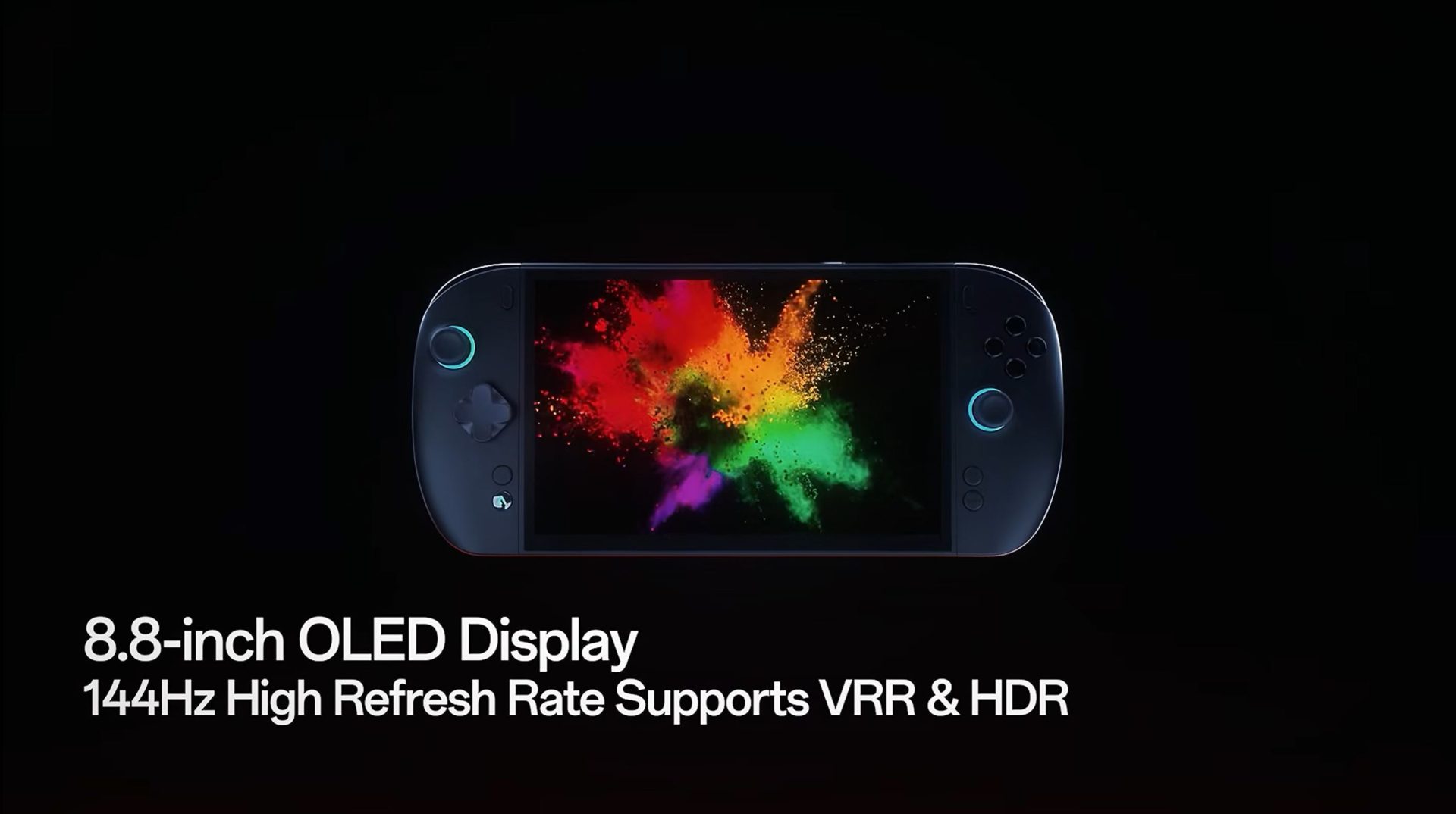
The standout feature is the display. A 9.06-inch AMOLED panel running at 165Hz with a 2400×1504 resolution delivers 313 PPI and covers 105% of the DCI-P3 color gamut. Peak brightness hits 1050 nits in HDR mode, with HDR10 support and a 1,000,000:1 contrast ratio. Corning Gorilla Glass 6 protects the screen, and the panel supports active stylus input. This is not a budget IPS panel. GPD is targeting enthusiasts who want the best visual experience possible in a portable form factor.
The convertible design lets you use the Win Max 3 as a traditional clamshell laptop with a built-in keyboard, or detach the controllers for handheld gaming. Two M.2 slots give you expansion flexibility, and memory configurations go up to 128GB of quad-channel LPDDR5x-8000 RAM. GPD also mentions a modular battery design, though specific capacity numbers are still missing. Connectivity includes USB4 with DisplayPort, HDMI 2.1, and Wi-Fi 6E.
The Reality Check
Here's the problem. The GPD Win Max 3 won't ship until August 2026. That's nearly a year away, and GPD has a history of delays. The company has launched multiple successful products, but also shipped devices with quality control issues, inconsistent customer support, and specs that didn't quite match the hype. The Win Max 2 had screen uniformity problems and thermal throttling under sustained loads. The Win 4 launched with a faulty joystick design that required a hardware revision.
There are no independent reviews of the Win Max 3 yet. All information comes directly from GPD's own marketing materials and spec sheets. The claimed 165Hz refresh rate is impressive, but can the Radeon 8060S actually drive AAA games at 2400×1504 at high frame rates? At 45W-110W TDP, this device will be a power hog. Battery life is likely measured in hours, not the full day you get from a Steam Deck at lower settings.
Price is another concern. GPD hasn't announced official pricing, but based on the Win Max 2's $1,099-$1,399 launch range and the upgraded specs here, expect $1,200 minimum, possibly $1,500+ for the 128GB model. That's Steam Deck OLED plus a gaming laptop money. You're paying a premium for the convertible form factor and cutting-edge display, but you're also betting on a niche manufacturer with inconsistent quality.
Who Actually Needs This
The Win Max 3 targets a very specific buyer. If you want the absolute best handheld gaming display available, and you're willing to pay for it, this delivers. The 165Hz AMOLED panel with HDR10 support is genuinely impressive on paper. Competitive gamers who play fast-paced shooters or racing games will appreciate the high refresh rate. Content creators who want a portable device for video editing or color-sensitive work might find value in the DCI-P3 coverage and 10-bit color depth.
The convertible laptop mode is useful if you genuinely need a Windows PC for productivity work alongside gaming. The detachable controllers mean you can use the device on a desk with a keyboard and mouse, then pop the controllers back on for couch gaming. This flexibility doesn't exist on the Steam Deck or ROG Ally.
But most gamers don't need this. The Steam Deck OLED costs $549 and delivers excellent image quality with a 90Hz HDR OLED screen. The ASUS ROG Ally X costs $799 and runs Windows natively with proven hardware. Both are shipping today, with real reviews, established ecosystems, and manufacturer support you can rely on. The performance gap between the Ryzen AI Max+ 395 and the Z1 Extreme in the Ally is real, but not night-and-day for most games at 720p-1080p.
The Verdict
The GPD Win Max 3 is an interesting device with genuinely impressive specs. The 165Hz AMOLED display alone sets it apart from every other handheld on the market. AMD's Ryzen AI Max+ 395 delivers desktop-class performance in a portable form factor. The modular design and dual M.2 slots give power users the flexibility they crave.
But it's also an expensive, unproven device from a manufacturer with a mixed track record, launching nearly a year from now. If you're considering a handheld gaming PC today, buy a Steam Deck OLED or ROG Ally X. Both are proven, available now, and cost significantly less. If you absolutely must have the best display tech and highest performance in a convertible handheld, bookmark the Win Max 3 and wait for independent reviews in late 2026. Don't preorder based on specs alone.
| Feature | GPD Win Max 3 | Steam Deck OLED | ROG Ally X |
|---|---|---|---|
| Display | 9.06" 165Hz AMOLED | 7.4" 90Hz OLED | 7" 120Hz IPS |
| Processor | Ryzen AI Max+ 395 | Custom AMD APU | Ryzen Z1 Extreme |
| RAM | Up to 128GB | 16GB | 24GB |
| Price | $1,199+ (est.) | $549 | $799 |
| Availability | August 2026 | Now | Now |
If GPD delivers on the promises, the Win Max 3 could be the most powerful handheld gaming PC on the market. But that's a big if. The company needs to prove it can ship on time, maintain quality control, and support customers post-launch. Until independent reviewers get hands-on time with retail units, this remains an expensive gamble rather than a sure bet.
Get it if
Enthusiasts who want the absolute best handheld display tech, need convertible laptop functionality, and are willing to wait and pay premium prices for cutting-edge specs.
Skip it if
You need a reliable handheld gaming PC today, want proven hardware with established support, care about value for money, or don't need 165Hz refresh rates for the games you play.
$1,199+
Affiliate links support the site at no cost to you.