#ai-hardware · 2026-09-30
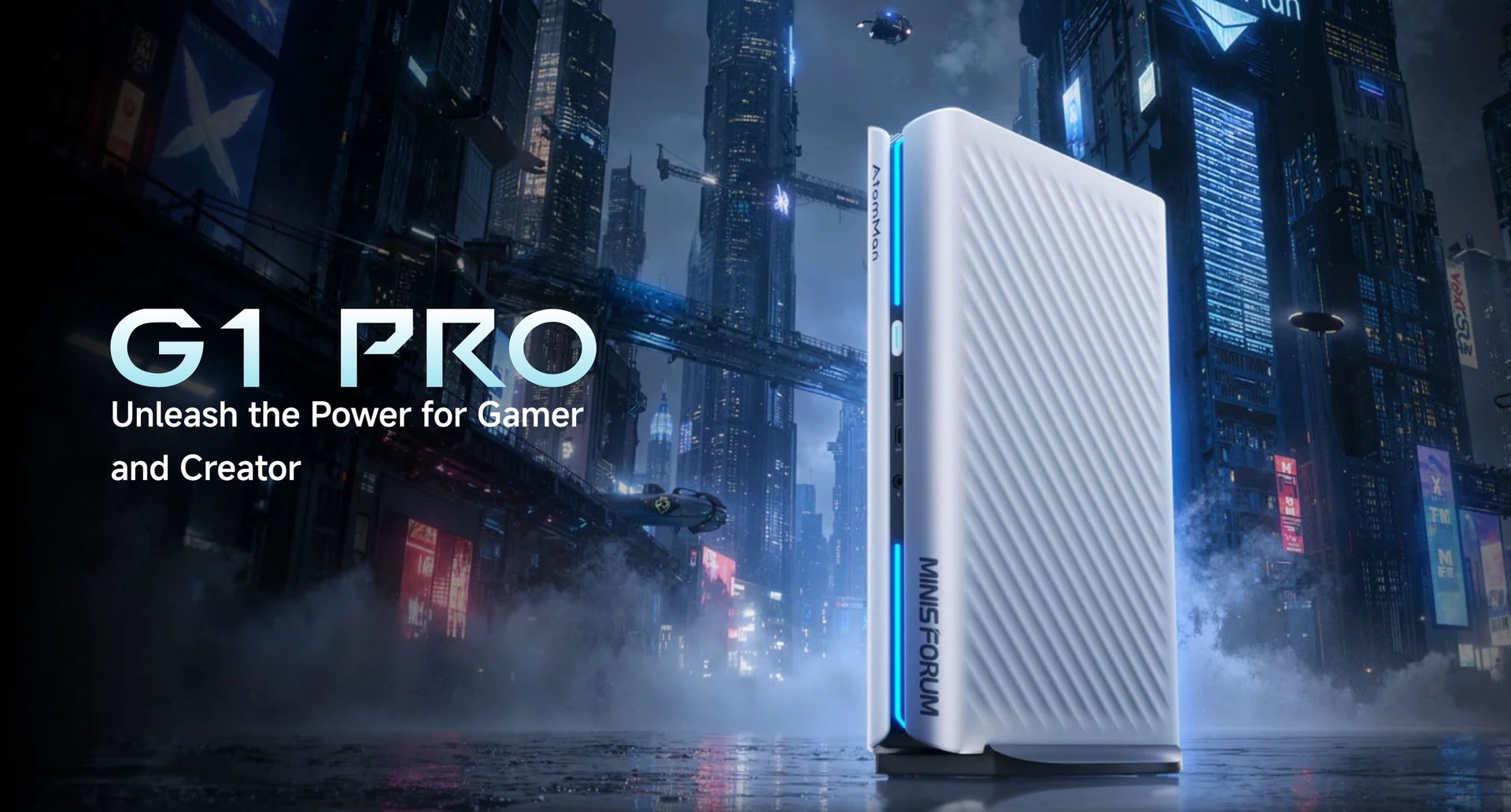
Minisforum AtomMan G1 Pro (AMD): 16GB VRAM in a Mini PC for $1759
The verdict
The 16GB VRAM advantage is real, but the downclocked GPU and steep price make this a niche pick for creators who need that memory more than raw speed.
$1759
What slaps
- +16GB VRAM vs 8GB on Nvidia alternative
- +Ryzen 9 8945HX handles demanding workloads
- +Upgradable to 96GB RAM and 8TB storage
What stings
- −RX 9060 XT downclocked to 140W from 160W reference
- −Expensive compared to mini PCs with similar CPUs
- −One fewer DisplayPort output than RTX 5060 model
🚩 Before you buy
- !GPU downclocked 20W below reference spec due to thermal constraints
- !Premium pricing compared to DIY builds with similar performance
Spec sheet
| CPU | AMD Ryzen 9 8945HX (16C/32T, up to 5.4 GHz) |
| GPU | AMD Radeon RX 9060 XT 16GB (140W TDP) |
| Memory | Up to 96GB DDR5 |
| Storage | Dual M.2 slots (up to 8TB total) |
| Networking | WiFi 7, Bluetooth 5.4, 5GbE LAN |
| Price | $1,759 |
How it stacks up
| Product | Price | Key spec | Verdict |
|---|---|---|---|
| AtomMan G1 Pro (AMD) | $1759 | RX 9060 XT 16GB | For VRAM-hungry workloads |
| AtomMan G1 Pro (Nvidia) | $1599 est. | RTX 5060 8GB | Better ray tracing, less VRAM |
| Beelink GTR7 Pro | $899 | Ryzen 9 7940HS, no dGPU | Much cheaper, iGPU only |
VRAM Doubling Comes at a Cost
Minisforum's AtomMan G1 Pro already existed with an Nvidia RTX 5060, but the new 89A6 variant swaps that for an AMD Radeon RX 9060 XT with 16GB of VRAM. On paper, that's a compelling upgrade. The extra 8GB of memory opens doors for 1440p gaming at higher texture settings, AI image generation with larger models, and creative workflows like video editing with heavier effects stacks. The Ryzen 9 8945HX remains unchanged, a 16-core Zen 4 mobile chip that peaks at 5.4 GHz and handles multithreaded work without breaking a sweat.
The catch is thermal reality. Minisforum lists the RX 9060 XT at 140W, 20W below AMD's reference spec. In a compact chassis, this makes sense to avoid throttling and fan noise, but it also means you're not getting the full performance AMD advertised. The original RTX 5060 model already faced cooling challenges, and adding a more power-hungry AMD GPU without drastically changing the cooling system suggests compromises were made. Real-world gaming will likely hit 60 FPS at 1440p ultra in most titles, but don't expect desktop replacement numbers.
Who Actually Needs 16GB VRAM?
The VRAM bump isn't just marketing fluff. If you're running local AI models, working with 4K video timelines, or gaming at 1440p with high-res texture packs, 8GB can bottleneck fast. The RX 9060 XT handles these scenarios more gracefully than the RTX 5060, which often forces you to dial down settings or wait longer for renders. For pure rasterization gaming, AMD also edges ahead of Nvidia at this tier, though ray tracing takes a hit.
That said, most mini PC buyers aren't pushing 1440p gaming or training neural nets. If you're streaming, light content creation, or 1080p gaming, the RTX 5060's 8GB is plenty, and you'll save around $160. The AMD variant makes sense for a narrow use case: creators and tinkerers who value memory capacity over raw clock speeds or ray tracing. If you're not in that camp, you're paying a premium for specs you won't fully leverage.
Build Quality and Connectivity
The physical design mirrors the original AtomMan G1 Pro. It's a well-built mini PC with solid build quality, though nothing groundbreaking for the price. You get dual M.2 slots supporting up to 8TB total storage, upgradable DDR5 RAM slots that max out at 96GB, and WiFi 7 alongside a 5GbE LAN port for fast wired connections. Port selection is robust, with multiple USB-A and USB-C options, but the AMD model loses one DisplayPort 2.1 output compared to the Nvidia version due to GPU I/O differences. If you run a triple-monitor setup, that matters.
Cooling is the elephant in the room. The compact form factor looks clean on a desk, but it forces thermal compromises. The downclocked GPU is a symptom, not a solution. Under sustained load, expect the fans to ramp up audibly. Minisforum doesn't publish noise levels, but similar mini PCs with discrete GPUs hover around 40-45 dB under stress. That's not loud enough to ruin a gaming session, but it's noticeable in a quiet office.
Comparing the Alternatives
| Model | Price | GPU | VRAM | Best For |
|---|---|---|---|---|
| AtomMan G1 Pro (AMD) | $1,759 | RX 9060 XT | 16GB | VRAM-heavy workloads |
| AtomMan G1 Pro (Nvidia) | ~$1,599 | RTX 5060 | 8GB | Ray tracing, DLSS |
| Beelink GTR7 Pro | $899 | Radeon 780M (iGPU) | Shared | Budget productivity |
The Nvidia variant of the G1 Pro costs roughly $160 less and offers better ray tracing and DLSS support, which matters for newer AAA games. If you care about frame generation or path tracing, Nvidia is the smarter pick. For pure rasterization and memory-bound tasks, AMD wins. The Beelink GTR7 Pro costs half as much and skips the discrete GPU entirely, relying on integrated Radeon 780M graphics. It's fine for light gaming and productivity but can't touch the performance of either G1 Pro variant.
The $1759 Question
At $1759, the AtomMan G1 Pro with AMD isn't an impulse buy. You're paying for the convenience of a mini PC that can game and create without needing a full tower. The 16GB VRAM is genuinely useful for specific workflows, but the downclocked GPU and thermal limits mean you're not getting desktop-class performance. If you need the portability and the VRAM, this hits a sweet spot. If you just want a capable gaming rig, a DIY build or a standard desktop will get you more power for less money.
Minisforum has carved out a niche here, but it's a narrow one. This isn't a machine for everyone. It's for the creator who needs VRAM more than clock speed, or the gamer who values desk space over raw FPS. If that's you, the AMD variant makes sense. For everyone else, the Nvidia model or a different form factor is a better fit.
Get it if
Content creators and AI tinkerers who need 16GB VRAM in a compact form factor and can live with downclocked performance.
Skip it if
You want maximum gaming performance per dollar, care about ray tracing, or don't need discrete GPU power in a mini PC.
$1759
Affiliate links support the site at no cost to you.