#ai-hardware · 2026-10-08
MSI Prestige N16 Flip AI+: NVIDIA's 1-Petaflop RTX Spark Chip Meets 2-in-1 Reality
The verdict
Groundbreaking tech for on-device AI, but ecosystem maturity and real-world performance remain unproven at announcement.
$2,499+ (estimated)
What slaps
- +NVIDIA RTX Spark superchip with 1 petaflop FP4 AI performance
- +Up to 128GB unified memory for large local AI models
- +16-inch UHD+ Tandem OLED touchscreen with 360-degree hinge
- +Windows on Arm with CUDA compatibility
What stings
- −Price likely premium for unproven platform
- −Windows on Arm app compatibility still relies heavily on emulation
- −Real-world AI performance benchmarks not yet available
- −Battery life under AI workloads unknown
🚩 Before you buy
- !No independent benchmarks or reviews available yet
- !Windows on Arm app compatibility still requires emulation for most software
- !Battery life under AI workloads completely unknown
- !First-generation platform with unproven thermal design
Spec sheet
| Processor | NVIDIA Grace CPU (Arm-based) |
| Graphics | NVIDIA Blackwell RTX GPU |
| AI Performance | Up to 1 petaflop (FP4) |
| Memory | Up to 128GB unified |
| Display | 16" UHD+ Tandem OLED, 120Hz |
| Form Factor | 360° convertible 2-in-1 |
| Storage | Not specified |
| Ports | SD Card Reader (others TBD) |
| Platform | Windows on Arm |
| Weight | Not specified |
| Price | $2,499+ (estimated) |
How it stacks up
| Product | Price | Key spec | Verdict |
|---|---|---|---|
| MSI Prestige N16 Flip AI+ | $2,499+ (est.) | RTX Spark, 1 PFLOP AI | Interesting |
| ASUS ProArt P16 | $2,299 | RTX 5000 Ada, Intel i9 | Buy |
| Dell XPS 14 (9440) | $1,899 | RTX 4050, Intel Ultra 7 | Buy |
The RTX Spark Promise
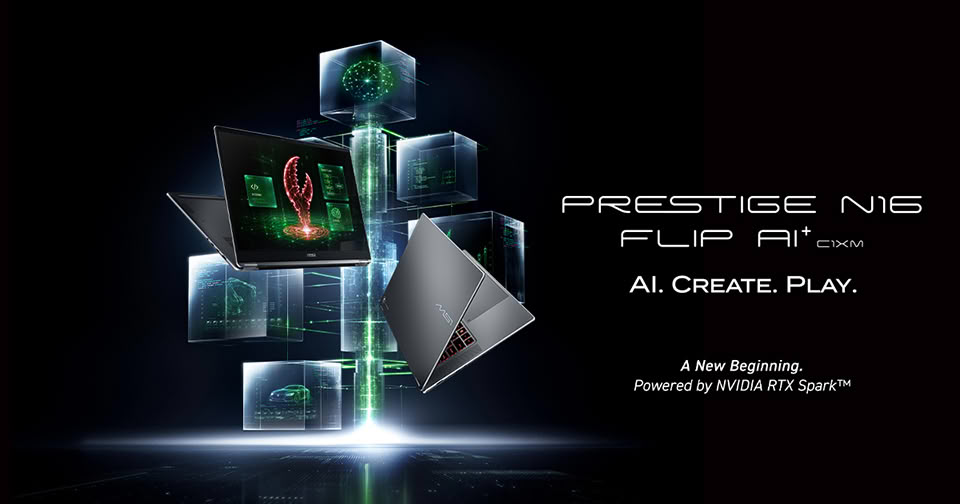
MSI's Prestige N16 Flip AI+ represents NVIDIA's bold entrance into the AI-first laptop market with its new RTX Spark platform. The superchip combines an Arm-based Grace CPU with a Blackwell RTX GPU, delivering what NVIDIA claims is up to 1 petaflop of FP4 AI performance with up to 128GB of unified memory. That's an astronomical figure on paper, designed to run large language models and AI agent workloads entirely on-device, no cloud required.
The promise is compelling: private AI that keeps your data local, eliminates cloud subscription costs, and responds instantly without network latency. NVIDIA is bringing CUDA, the de facto standard for AI development, to a thin-and-light Windows laptop. For creators, developers, and AI enthusiasts, this sounds like the future arriving early.
But here's the reality check: the Prestige N16 Flip AI+ was just announced for pre-order in select markets. No independent benchmarks exist yet. No one outside MSI and NVIDIA has run real AI workloads on this hardware. We're evaluating a promise, not a product.
What Makes RTX Spark Different
Unlike traditional laptop architectures where CPU and GPU access separate memory pools, RTX Spark uses unified memory architecture. Both the Grace CPU and Blackwell GPU share the same memory space, up to 128GB. This matters enormously for AI workloads, which often require loading massive models into VRAM. Unified memory means a 70-billion parameter model can theoretically run without the bottleneck of shuffling data between CPU RAM and GPU VRAM.
The Blackwell GPU brings hardware-accelerated ray tracing, DLSS upscaling, and NVIDIA Reflex for gaming, plus CUDA support for broad AI framework compatibility. TensorFlow, PyTorch, and most AI development tools expect CUDA. Windows on Arm has historically struggled with developer adoption, but CUDA changes the equation.
| Feature | MSI Prestige N16 Flip AI+ | ASUS ProArt P16 | Dell XPS 14 |
|---|---|---|---|
| Platform | RTX Spark (Arm) | x86 (Intel) | x86 (Intel) |
| AI Performance | 1 PFLOP (FP4) | ~200 TFLOPS (INT8) | ~100 TFLOPS (INT8) |
| Unified Memory | Up to 128GB | No (32GB max GPU) | No (16GB max GPU) |
| Form Factor | 360° convertible | Clamshell | Clamshell |
| Software Compatibility | Arm-native + emulation | Full x86 | Full x86 |
The 2-in-1 Form Factor
MSI positioned the Prestige N16 Flip AI+ as the only convertible in the first wave of RTX Spark laptops. The 16-inch UHD+ Tandem OLED display with 120Hz refresh and 360-degree hinge transforms into tablet, tent, and presentation modes. The bundled MSI Nano Pen adds stylus input, and the Action Touchpad is 53% larger than previous MSI models. An SD card reader and quad-speaker audio round out the creative workstation features.
On paper, this is the AI workstation for creators who sketch, edit video, and run inference models in the same session. Flip to tablet mode for note-taking with the pen, tent mode for client presentations, laptop mode for coding. It's versatile, assuming the hinge mechanism holds up under real use and the device isn't too heavy for comfortable tablet holding.
The Windows on Arm Question
Windows on Arm has been Microsoft's white whale since the original Surface RT in 2012. Each iteration promises better app compatibility through emulation, and each generation improves incrementally. The Prestige N16 Flip AI+ runs Arm-native apps at full speed and relies on emulation for x86 software. NVIDIA claims CUDA compatibility bridges the gap for AI developers, but general productivity software, creative apps, and games may still hit emulation overhead.
Adobe's Creative Cloud, Autodesk tools, and most professional Windows software remain x86. If you're betting on this laptop for your daily workflow, you're betting Microsoft and developers have finally cracked Arm compatibility. History suggests caution.
What We Don't Know Yet
Battery life is the obvious missing data point. Running AI inference locally is compute-intensive. How long does the Prestige N16 Flip AI+ last under typical workloads versus heavy model inference? NVIDIA promises instant-on responsiveness on battery, but quantified hours matter more than marketing language.
Real-world AI performance is equally opaque. FP4 precision is lower than the FP16 or FP32 most researchers use for training. Inference at FP4 is viable for many models, but quality degradation compared to higher precision is model-dependent. Without independent testing, we can't validate whether 1 petaflop FP4 translates to usable performance on Llama 3, Stable Diffusion, or other common workloads.
Thermal management in a thin convertible chassis is another unknown. Blackwell GPUs are efficient, but sustained AI workloads generate heat. Does MSI throttle under load? How loud are the fans?
Who Should Pre-Order
Early adopters and AI researchers willing to bet on NVIDIA's platform have a clear value proposition here. If you need to run large models locally for privacy, regulatory compliance, or offline work, the unified memory architecture is genuinely differentiated. The 128GB configuration could handle models that simply won't fit in traditional laptop GPU VRAM.
For everyone else, waiting for reviews, benchmarks, and real-world validation is the smart move. This is first-generation hardware on a new platform. Software ecosystems take time to mature. Windows on Arm compatibility improves with each release, but it's not seamless yet.
The Competition
Traditional x86 creator laptops like the ASUS ProArt P16 ($2,299) offer RTX 5000 Ada GPUs with 16GB VRAM, Intel Core i9 processors, and full Windows software compatibility. You lose unified memory and get lower theoretical AI performance, but you gain a proven platform with known thermals, battery life, and app support.
Dell's XPS 14 ($1,899) with RTX 4050 and Intel Ultra 7 delivers solid creative performance at a lower price point, though with significantly less AI horsepower. If you're not running inference workloads daily, it's a more practical buy.
The Verdict
The MSI Prestige N16 Flip AI+ is genuinely innovative hardware. NVIDIA's RTX Spark platform could redefine what's possible in mobile AI computing, and MSI's 2-in-1 execution looks thoughtful on paper. The 16-inch OLED display, convertible hinge, and bundled pen address real creator needs.
But innovation and execution are different. Pre-ordering an unreviewed laptop on a first-generation platform is a gamble. If you're building AI agents, fine-tuning models, or running inference workloads that justify the unified memory architecture, the risk may be worth it. For everyone else, let the early adopters validate battery life, thermals, app compatibility, and real-world AI performance before committing.
This is a Watch rating, not a Skip. The technology is promising. The execution is unproven. Wait for independent reviews unless you're specifically building for on-device AI and understand the tradeoffs of Windows on Arm.
Get it if
AI researchers and developers who need to run large models locally with unified memory, early adopters willing to bet on NVIDIA's new platform, creators who specifically need convertible form factor with AI acceleration.
Skip it if
You need proven Windows app compatibility, established battery life metrics, or can't afford to be a platform guinea pig. Wait for reviews if you're risk-averse.
$2,499+ (estimated)
Affiliate links support the site at no cost to you.