the wire · #topnews · 2026-11-21
A Space Probe Returns to Asteroids Where NASA Tested Planetary Defense Systems
Cech Tech Reviews
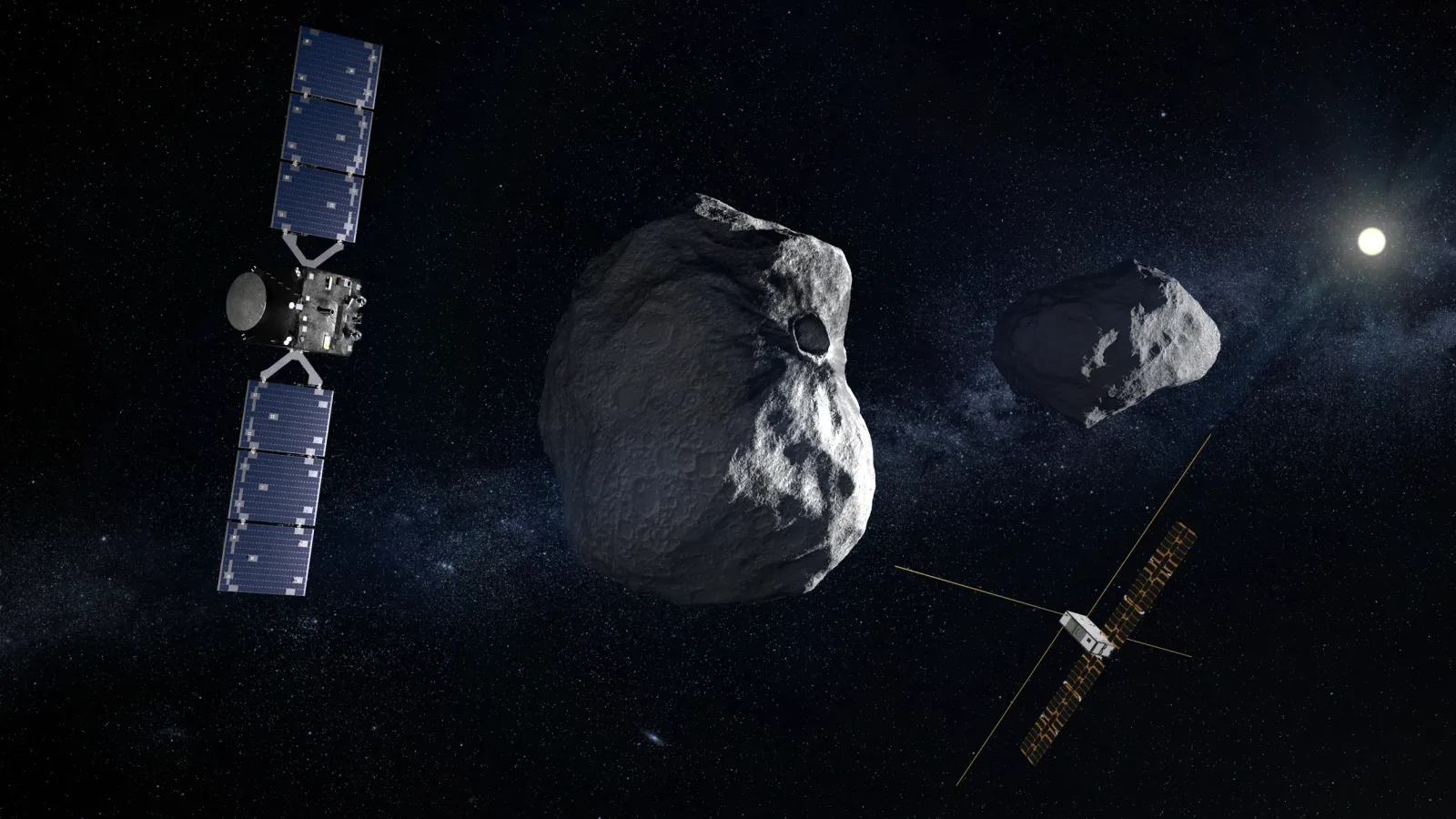
The European Space Agency's Hera probe is currently making its way back to the Didymos asteroid system, a journey that marks a pivotal moment in our ability to protect Earth from cosmic threats. This mission serves as the essential follow-up to NASA's DART impact, which successfully altered the orbit of a small moonlet in 2022. While the initial test proved that kinetic impact could deflect an asteroid, the real science begins now with Hera's arrival.
According to recent reporting, Hera is equipped with advanced instruments designed to map the crater left by the DART spacecraft. It will also deploy two CubeSats to conduct close-up surveys of both the primary asteroid and its smaller companion. This level of detail was impossible to achieve during the initial impact event, which was primarily a proof-of-concept demonstration rather than a detailed forensic investigation.
The data Hera collects will allow scientists to determine exactly how much mass was ejected during the collision and how that momentum transfer affected the moonlet's trajectory. This information is crucial for refining the mathematical models used to predict the outcomes of future deflection attempts. Without these precise measurements, our understanding of planetary defense remains largely theoretical.
This mission highlights a growing trend in space exploration where international cooperation is key to solving complex problems. The synergy between NASA's aggressive initial test and the ESA's meticulous follow-up demonstrates how different agencies can complement each other's strengths. It also signals a shift from purely scientific observation to active planetary stewardship.
For AI professionals, the implications extend beyond space. The data processing challenges involved in analyzing high-resolution asteroid imagery and simulating impact dynamics are directly relevant to computer vision and physics-based machine learning models. The techniques used to detect subtle changes in asteroid shape and mass distribution can be adapted for industrial inspection and predictive maintenance tasks.
What this means for you: The algorithms used to process Hera's data will likely rely on advanced computer vision techniques to identify surface changes. You can experiment with similar pattern recognition workflows by using an AI assistant to analyze high-resolution satellite imagery of construction sites or geological formations. Try this prompt: "Analyze this satellite image to identify subtle structural changes over time and suggest potential maintenance issues based on visual anomalies."
The success of this mission could pave the way for more frequent and complex planetary defense exercises. As we develop better tools to monitor and deflect near-Earth objects, the technology will inevitably trickle down into other sectors. The intersection of space exploration and artificial intelligence is creating new opportunities for data-driven decision making in high-stakes environments.
Reporting basis: original story
← back to The Wire