#ai-hardware · 2026-07-22
AMD EPYC Venice: 256 Cores on 2nm Process Redefine Data Center Performance
The verdict
Groundbreaking tech for enterprises, but wait for real-world benchmarks and competitive pricing before committing to a platform upgrade.
TBD (est. $10,000-$15,000+)
What slaps
- +256 cores with 512 threads, 33% jump from Turin generation
- +First 2nm HPC chip in volume production with GAA transistors
- +16-channel DDR5 memory for 1.6 TB/s bandwidth
- +70% performance improvement over EPYC Turin in AI workloads
- +PCIe 6.0 support doubles CPU-to-GPU bandwidth
What stings
- −No confirmed pricing or availability date yet
- −Requires new SP7 socket, forcing complete platform upgrade
- −Unproven 2nm yield and thermal characteristics at scale
- −Consumer Zen 6 Ryzen chips delayed due to memory shortages
- −Marketing claims lack third-party validation
🚩 Before you buy
- !No third-party benchmarks or independent validation of performance claims
- !Pricing and power consumption figures not disclosed
- !Requires full platform refresh with new SP7 socket
- !Consumer Zen 6 Ryzen chips delayed, raising questions about supply chain readiness
Spec sheet
| Architecture | Zen 6 |
| Process Node | TSMC N2 (2nm GAA) |
| Max Cores/Threads | 256 cores / 512 threads |
| CCDs | 8 compute dies (32 cores each) |
| I/O Dies | 2 massive dies |
| Memory Channels | 16-channel DDR5 |
| Memory Bandwidth | Up to 1.6 TB/s |
| Socket | SP7 (new) |
| PCIe Support | PCIe 6.0 |
| Target Market | AI data centers, HPC |
How it stacks up
| Product | Price | Key spec | Verdict |
|---|---|---|---|
| AMD EPYC Venice (Zen 6) | TBD | 256 cores, 2nm | Cutting-edge, wait for benchmarks |
| AMD EPYC Turin (Zen 5) | $8,000-$12,000 | 192 cores, 3nm | Proven, available now |
| Intel Xeon 6 Sierra Forest | $7,500-$11,000 | 288 E-cores, Intel 3 | Higher core count, less IPC |
The 2nm Era Arrives for Data Centers
AMD's EPYC Venice, showcased at the Advancing AI 2026 event in San Francisco, marks a genuine inflection point in server chip design. This is the first high-performance computing processor to enter volume production on TSMC's 2nm N2 process, abandoning FinFET transistors for nanosheet gate-all-around (GAA) technology. The result is a 256-core, 512-thread behemoth aimed squarely at AI inference, agentic workloads, and reinforcement learning tasks that increasingly dominate data center deployments.
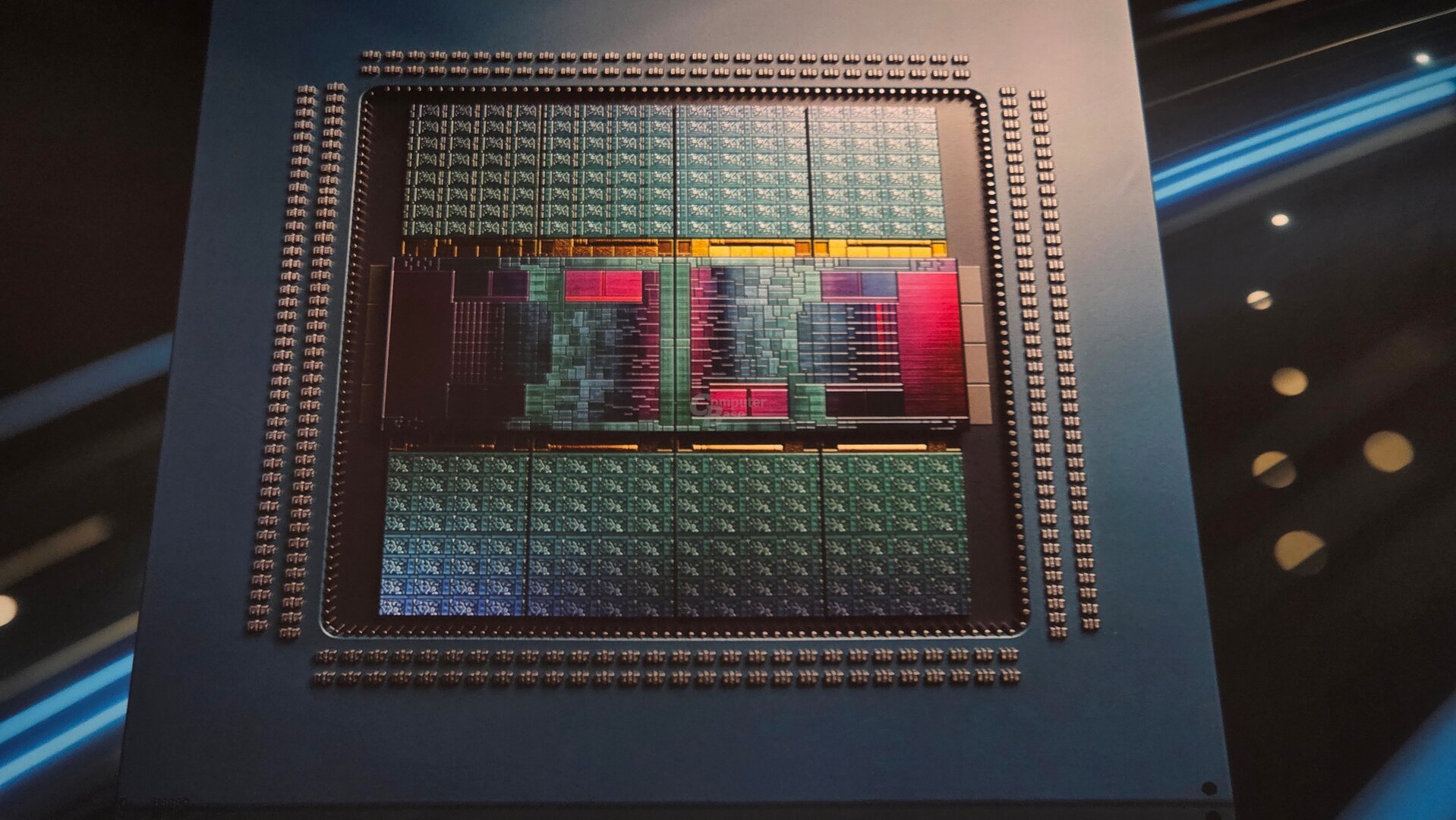
The chip itself is a visual spectacle. Leaked images from AMD's banners at Moscone Center West reveal eight massive compute chiplet dies (CCDs), each housing 32 cores split into two 16-core complexes. Between them sit two enormous I/O dies managing memory controllers, PCIe 6.0 lanes, and UCIe interconnects. This isn't just a core count bump, it's a fundamental rethink of how CPUs feed accelerators and manage memory-intensive workloads.
What TSMC's 2nm Process Actually Delivers
TSMC's N2 node is a generational leap, not an incremental tweak. The shift to GAA transistors brings 10-15% higher performance at the same power envelope, or 25-30% lower power consumption at equivalent performance, compared to the N3E node used in EPYC Turin. Transistor density improves by up to 15%, which AMD leverages to pack more cache and logic into each die without ballooning chip size.
For Venice, this translates to a 70% claimed performance improvement over Turin in AI-centric benchmarks, though AMD has yet to release third-party validated numbers. The 33% increase in core count (from 192 to 256) accounts for part of that gain, but the rest comes from IPC (instructions per cycle) improvements, higher sustainable clocks, and uncore optimizations. The architecture benefits from tighter integration between compute dies and I/O logic, reducing latency bottlenecks that plague multi-chiplet designs.
Memory Bandwidth Solves the Real Bottleneck
Venice introduces a new SP7 socket with 16 DDR5 memory channels per socket, delivering aggregate bandwidth of 1.6 TB/s. This is critical. AI workloads, especially large language model inference and agentic reasoning loops, are increasingly memory-bound. Throwing more cores at the problem only helps if you can keep them fed with data.
AMD also doubles CPU-to-GPU bandwidth over the current platform by adopting PCIe 6.0, which delivers 128 GB/s per x16 slot compared to PCIe 5.0's 64 GB/s. In practice, this means tighter coupling between EPYC Venice CPUs and AMD's Instinct MI455X GPUs in Helios rack systems. For mixed CPU-GPU workflows, where the CPU orchestrates tasks and the GPU handles heavy compute, this bandwidth upgrade eliminates a major stall point.
The Core Count Arms Race and Its Limits
Venice's 256 cores position it between AMD's own EPYC Turin (192 cores) and Intel's Xeon 6 Sierra Forest (288 E-cores). Intel's chip has more threads, but uses efficiency cores with lower per-core performance. Venice's Zen 6 cores are full-fat, high-IPC designs better suited to single-threaded or lightly-threaded workloads that still run in data centers, such as database queries, web serving, and front-end AI inference.
The question is whether enterprises need 256 cores in a single socket. For highly parallel workloads like video encoding, molecular dynamics, or distributed training, yes. For traditional virtualized workloads or databases with licensing tied to core count, Venice might actually increase software costs faster than it improves performance. This isn't a chip for every data center, it's optimized for AI-first infrastructure.
What's Missing: Pricing, Power Draw, and Real Benchmarks
AMD has not disclosed Venice's TDP, pricing, or firm availability date. Based on EPYC Turin's range ($8,000 to $12,000 for high-core-count SKUs), expect Venice to start around $10,000 for mid-tier models and exceed $15,000 for the 256-core flagship. Power consumption is the bigger unknown. TSMC's 2nm node is more efficient per transistor, but Venice packs significantly more silicon. If TDP climbs above 400W, cooling and power delivery become serious infrastructure costs.
Performance claims are equally vague. AMD cites up to 70% improvement in "overall performance and efficiency" and 1.7x faster AI throughput, but these are cherry-picked workload results, not SPECrate or standardized benchmarks. Until third-party testers publish independent data, treat these numbers as best-case scenarios.
Platform Lock-In and the SP7 Socket
Venice requires the new SP7 socket, which is incompatible with SP5 used by EPYC Turin and Genoa. This means a full platform refresh: new motherboards, new validation, new firmware. For enterprises running large EPYC deployments, this is a multi-million-dollar decision. AMD's track record with socket longevity (AM4 lasted five years, SP3 spanned three generations) suggests SP7 will be around for a while, but early adopters bear the risk of teething issues.
| Processor | Cores | Process | Memory BW | Availability |
|---|---|---|---|---|
| AMD EPYC Venice | 256 | TSMC 2nm | 1.6 TB/s | Q4 2026 (est) |
| AMD EPYC Turin | 192 | TSMC 3nm | 1.2 TB/s | Available now |
| Intel Xeon 6 Sierra Forest | 288 E-cores | Intel 3 | 1.0 TB/s | Available now |
Implications for Consumer Zen 6
Venice offers a preview of Zen 6 architecture before it reaches consumer Ryzen chips, but don't expect a direct translation. Desktop Zen 6 will likely feature fewer cores (16-24), higher clocks, and more L3 cache tuned for gaming and single-threaded apps. The IPC and efficiency improvements from TSMC's 2nm node should carry over, but Ryzen launch has been pushed into 2027 due to DRAM shortages affecting supply chains.
The Verdict: Cutting-Edge Tech, Real-World Unknowns
EPYC Venice is objectively impressive. The move to 2nm, the 256-core design, and the memory bandwidth upgrades all address real pain points in AI-driven data centers. But without confirmed pricing, power specs, or independent benchmarks, it's too early to call this a must-buy. Enterprises with AI workloads should watch closely, current EPYC Turin deployments remain a safe, proven choice until Venice proves itself in production. For the rest of us, this is a glimpse of where CPU design is headed, even if we won't see Zen 6 in our own machines for another year.
Get it if
Hyperscalers and enterprises running AI inference, agentic workflows, or reinforcement learning at scale who need maximum thread density and memory bandwidth.
Skip it if
You're running traditional virtualized workloads, have per-core software licensing costs, or need proven thermal and power characteristics before committing capital.
TBD (est. $10,000-$15,000+)
Affiliate links support the site at no cost to you.