#ai-hardware · 2026-09-24
Meta VR Glasses: $1,299 Gets You 100-Gram VR That Ditches Controllers
The verdict
Impressive tech, but spring 2027 launch, no controllers included, and unproven hand tracking for productivity make this a wait-and-see.
$1,299.99
What slaps
- +100-gram glasses form factor is genuinely portable
- +5K micro-OLED with 37 PPD delivers sharp text for productivity
- +Hand tracking and eye control eliminate controller dependency
- +Three-hour battery for continuous media playback
What stings
- −No controllers included at $1,299, sold separately
- −Spring 2027 launch leaves months of waiting
- −Hand tracking unproven for extended productivity work
- −Heavier 300g compute puck still needs pocket or bag space
🚩 Before you buy
- !Spring 2027 launch means buying on promises, not proven hardware
- !No controllers included at $1,299, adding unknown extra cost
- !Hand tracking unproven for extended productivity or gaming
Spec sheet
| Weight (Glasses) | ~100 grams |
| Weight (Compute Puck) | ~300 grams |
| Display | 5K micro-OLED, 37 PPD, Dolby Vision |
| Processor | Snapdragon Reality Elite |
| Storage | 128GB + microSD slot (up to 1TB) |
| Battery Life | 3 hours continuous playback |
| Charging | 45W USB-C fast charging |
| Audio | Dolby Atmos spatial audio |
| Input | Hand tracking, eye tracking, voice (Meta AI) |
| Controllers | Sold separately (Touch Plus compatible) |
| Price | $1,299.99 |
| Release | Spring 2027 |
How it stacks up
| Product | Price | Key spec | Verdict |
|---|---|---|---|
| Meta VR Glasses | $1,299 | 100g, 5K micro-OLED, hand/eye tracking | Wait for reviews |
| Steam Frame | $1,059 | Full headset, controllers included, available now | Better value today |
| Meta Quest 3 | $500 | Heavier but complete, proven ecosystem | Best for VR gaming |
The 100-Gram Promise
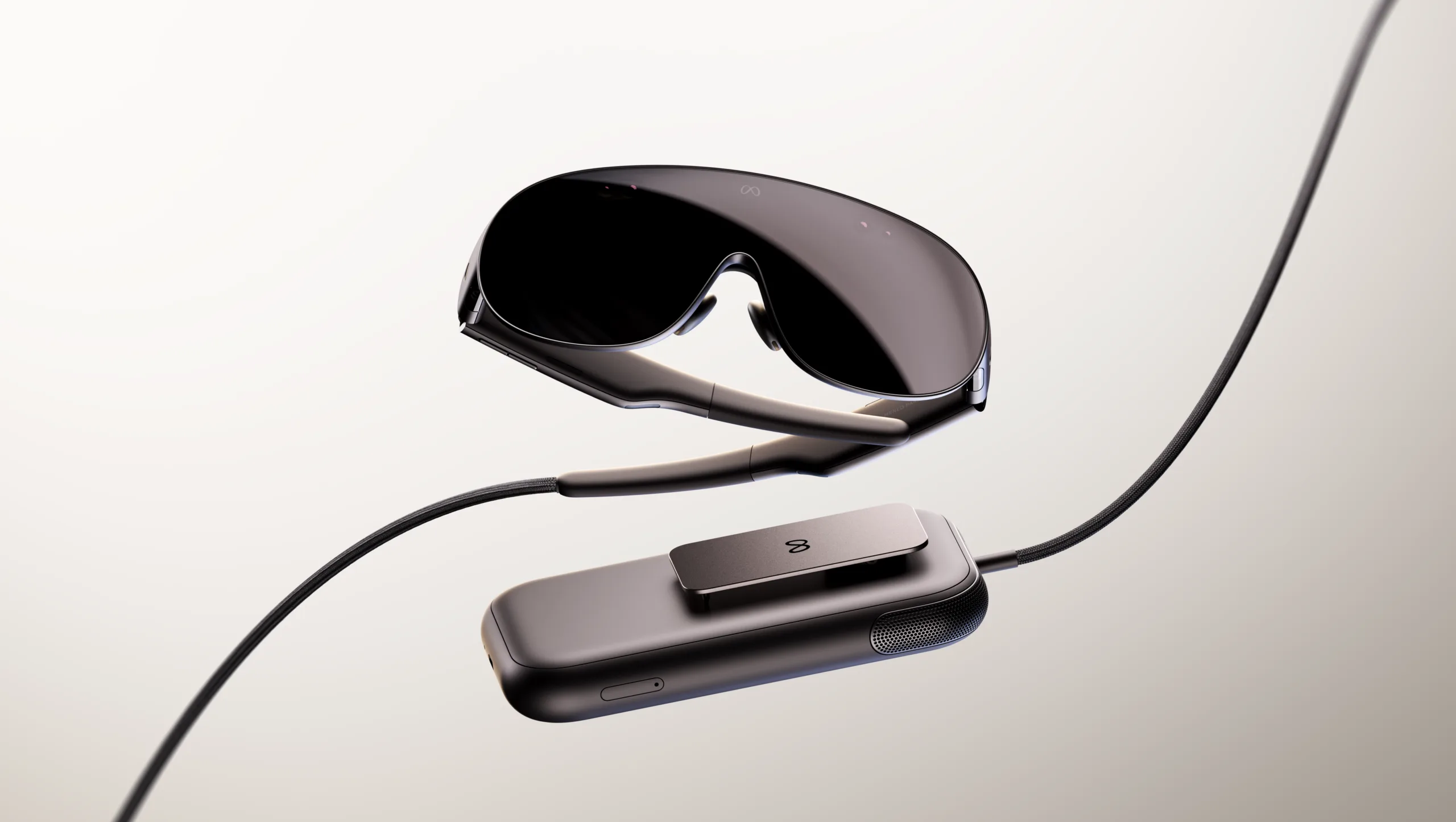
Meta's VR Glasses strip VR down to its essence. At roughly 100 grams, the glasses portion sits on your face like a chunky pair of sunglasses while a 300-gram compute puck handles processing, battery, and storage via an optical tether. The pitch is simple: no straps, no front-heavy weight, just a pair of glasses you can wear on a flight or at a coffee shop without looking like you're escaping reality entirely.
The micro-OLED panels deliver 5K resolution at 37 pixels per degree, significantly sharper than Quest 3's 25 PPD. Text legibility matters here because Meta is positioning these as a laptop alternative, a portable workspace where you can have multiple virtual monitors floating in your field of view. Dolby Vision and Dolby Atmos support suggest Meta is serious about the cinema experience too, partnering with IMAX and Disney for 3D content.
But here's the catch: at $1,299.99, you get the glasses, the puck, a power supply, and a microSD slot. No controllers. No microSD card. Quest 3 or Quest 3S controllers will pair if you already own them, or you can buy Touch Plus controllers separately at an undisclosed price. For a device marketed as a new era in VR, shipping without input beyond hand tracking feels like an incomplete package.
Hand Tracking as the Default Input
Meta is betting hard on hand and eye tracking as the primary interface. You pinch, point, and look to navigate menus, launch apps, and control your virtual workspace. Meta AI voice commands add another layer, letting you speak requests instead of fumbling through gestures. On paper, it's elegant. In practice, hand tracking has been a mixed experience across the VR industry.
Meta's demos show smooth interactions, pinching to select, swiping to scroll, and using eye gaze to direct focus. But anyone who has used Quest's hand tracking knows it can be finicky in less-than-ideal lighting, tiring after extended use, and imprecise compared to physical controllers. For casual media consumption, hand tracking is fine. For productivity work where you're manipulating virtual windows for hours, the jury is still out.
The Snapdragon Reality Elite processor is new, built specifically for high-performance mixed reality. Fast load times and breakthrough efficiency are promised, but we won't know how well the system handles multitasking, background apps, or thermal management until spring 2027 when the device actually ships.
Portable Laptop Alternative or Niche Media Device?
Three hours of continuous high-resolution playback is the stated battery life, with 45W fast charging to top up quickly. That's enough for a movie or a short work session, but falls short of a full workday. The puck clips to your pocket or bag, which is more portable than a Quest 3 tethered to a PC, but less seamless than a true standalone device.
Meta's pitch centers on portability and privacy. You can work on a plane without the person next to you seeing your screen, or watch a movie in a hotel room without a TV. But the same could be said for a laptop, which also offers a keyboard, touchpad, and the ability to function as a laptop when you're done with VR. The form factor is lighter, but the use case still feels speculative.
The open sides and passthrough camera keep you aware of your surroundings, a nod to spatial computing safety and social acceptability. But the lenses are opaque, not translucent, so you're still visibly cut off from the world. It's less isolating than a full headset, but not invisible.
| Spec | Meta VR Glasses | Steam Frame | Quest 3 |
|---|---|---|---|
| Weight (Face) | 100g | ~500g | 515g |
| Resolution | 5K micro-OLED, 37 PPD | 4K LCD, 30 PPD | 4K LCD, 25 PPD |
| Controllers | Sold separately | Included | Included |
| Battery | 3 hours (puck) | 2-3 hours | 2.2 hours |
| Price | $1,299 | $1,059 | $500 |
The Alternatives You Can Buy Today
Steam Frame launched nine days before Meta's announcement at $1,059 and includes controllers in the box. It's heavier at around 500 grams, but it's a complete system available now with a proven library of SteamVR titles. If you want high-end VR today, Steam Frame offers better value and no waiting period.
Quest 3 at $500 is half the price and still delivers excellent mixed reality experiences. It's heavier on your face, but the ecosystem is mature, controllers are included, and you're not betting on unproven hand tracking for every interaction. For VR gaming, Quest 3 remains the better choice.
Apple Vision Pro starts at $3,699 and targets a different market entirely, but it shares Meta's focus on spatial computing and hand tracking. Vision Pro's eye and hand tracking is reportedly smoother, but the price and weight make it less portable.
What Meta Got Right and Wrong
The form factor is genuinely impressive. Shaving weight down to 100 grams on your face is a meaningful step toward all-day wearability, and the micro-OLED clarity could make text work viable in VR. The IMAX and Disney partnerships show Meta is investing in content that leverages the hardware.
But shipping without controllers at $1,299 is a baffling decision. Hand tracking is impressive in demos, but it's not a proven replacement for physical input in productivity or gaming scenarios. The spring 2027 release date means early adopters are preordering based on promises, not reviews. And the compute puck, while lighter than a headset, still adds bulk and a tether that limits true portability.
Should You Wait or Buy Something Else?
Wait. The tech is promising, but Meta is asking you to pay a premium for a product that won't ship for months, relies on unproven input methods, and costs more than Steam Frame while excluding controllers. If hand tracking delivers on its promise and the productivity software ecosystem matures, Meta VR Glasses could justify their price. But today, you're buying into potential, not proven performance.
If you need VR now, Steam Frame offers higher-end hardware with controllers included, and Quest 3 delivers a complete, affordable experience. Meta VR Glasses are interesting, but not worth the leap of faith at launch.
Get it if
Early adopters willing to wait and bet on hand tracking as the future of VR input, or media enthusiasts who prioritize portability and display quality over gaming
Skip it if
You need VR hardware today, want controllers included at this price point, or rely on precise input for productivity or gaming
$1,299.99
Affiliate links support the site at no cost to you.