#ai-hardware · 2026-08-07
GMKtec EVO X3: 128GB Unified Memory and Desktop-Class GPU in a Mini Tower
The verdict
Exceptional raw performance and cooling, but the $3,600 price and tower form factor make it a niche choice best suited for users who need 128GB unified memory and local AI inference.
$3,600
What slaps
- +128GB LPDDR5X-8000 unified memory enables large AI model inference locally
- +Radeon 8060S iGPU beats desktop RTX 4060 in 3DMark, handles 1440p gaming at 90+ FPS
- +Triple-fan cooling keeps temps under 66°C during gaming, 83°C under stress testing
What stings
- −$3,600 price point is steep compared to traditional mini PCs or even some workstations
- −Tower design abandons the space-saving appeal of typical mini PCs
- −Limited to single configuration, no RAM or CPU customization options
Spec sheet
| Processor | AMD Ryzen AI Max+ 395 (16-core, 32-thread, up to 5.1 GHz) |
| Graphics | AMD Radeon 8060S iGPU |
| Memory | 128 GB LPDDR5X-8000 (Unified) |
| Storage | Dual M.2 2280 PCIe Gen 4x4 slots (up to 16 TB total) |
| AI Performance | 50 TOPS NPU (Copilot+ certified) |
| Max TDP | 140W |
| Connectivity | USB 4, HDMI 2.1, Wi-Fi 7, Bluetooth 5.3, OCuLink |
| OS | Windows 11 (pre-installed) |
| Cooling | Triple-fan system |
| Price | $3,600 |
| Launch Date | July 6, 2026 |
How it stacks up
| Product | Price | Key spec | Verdict |
|---|---|---|---|
| GMKtec EVO X3 | $3,600 | 128GB unified RAM, 50 TOPS NPU, Radeon 8060S | Best for local AI + gaming |
| Mac Studio (M1 Ultra) | $3,999 | 128GB RAM, 20-core CPU, slower in Cinebench R24 | macOS ecosystem lock-in |
| Minisforum MS-A1 | $1,899 | Ryzen 9 7945HX, 64GB RAM, weaker iGPU | Half the price, half the RAM |
Tower Design Trades Compactness for Thermal Headroom
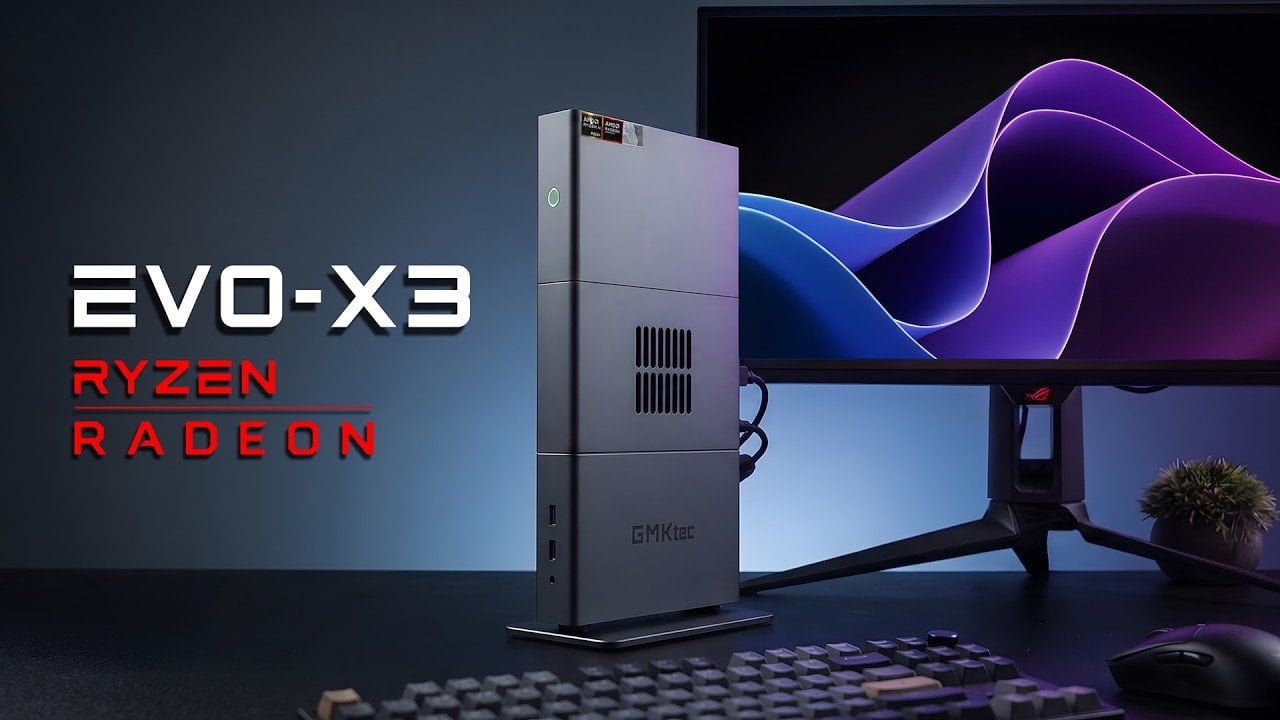
The GMKtec EVO X3 breaks from the company's previous flat mini PC designs, adopting a vertical tower form factor to house a triple-fan cooling system. This shift addresses thermal complaints from the EVO-X2, which suffered from fan noise and throttling under load. The tower occupies a footprint similar to an upright PlayStation 4, sacrificing the space-saving appeal typical of mini PCs but gaining stable clock speeds during sustained workloads.
The chassis features subtle green accents and a modern industrial aesthetic. Three fans pull air through the tower, keeping the AMD Ryzen AI Max+ 395 processor under 83°C even during stress testing. During real-world gaming sessions, ETA Prime measured temps around 66°C, with power draw peaking at 147W. This thermal performance justifies the larger footprint if you're running AI inference models, rendering tasks, or extended gaming sessions where sustained performance matters more than desk space.
AMD Ryzen AI Max+ 395: 16 Cores and 50 TOPS of AI Grunt
The EVO X3 runs AMD's Ryzen AI Max+ 395, a 16-core, 32-thread processor codenamed Strix Halo. It integrates a CPU, Radeon 8060S iGPU, and a dedicated NPU capable of 50 TOPS, exceeding Microsoft's 40 TOPS baseline for Copilot+ certification. Geekbench 6 shows single-core scores of 3,081 and multi-core scores of 22,314, trailing Apple's M4 Max by 23% and 18% respectively. While Apple's single-threaded performance leads, the Ryzen chip holds its own in multi-threaded workloads and GPU-accelerated tasks.
The real standout is the Radeon 8060S iGPU. In 3DMark Time Spy Graphics, it beats the desktop RTX 4060 by 10%, a rare achievement for integrated graphics. The 140W max TDP gives the iGPU breathing room to flex, unlike mobile chips strangled by lower power envelopes. In Forza Horizon 6, the EVO X3 hit 90+ FPS at 1440p ultra settings without FSR. Demanding titles like Black Myth Wukong and Crimson Desert required FSR to stay above 60 FPS at 1440p high, but this is still impressive for an iGPU. The EVO X3 handles 1440p AAA gaming comfortably, making it a viable option for users who want one machine for work and play.
128GB Unified Memory: The Real Differentiator
The EVO X3 ships with 128GB of LPDDR5X-8000 unified memory, shared between CPU, GPU, and NPU. This is the feature that justifies the $3,600 price for a specific audience: users running large language models locally. With 128GB unified RAM, the EVO X3 can load models up to 235 billion parameters without offloading to disk, making it competitive with Mac Studio setups but on Windows. GMKtec bundles proprietary OpenClaw software for local AI inference, targeting professionals who need privacy or low-latency responses without relying on cloud APIs.
For non-AI users, 128GB is overkill. Most gaming and productivity workflows max out at 32GB or 64GB. The unified memory architecture benefits GPU-intensive tasks like 3D rendering and video editing, where the iGPU can access the full 128GB pool without copying data across separate VRAM. If your workflow involves running multiple VMs, massive datasets, or AI workloads, the unified memory makes sense. Otherwise, you're paying for capacity you won't use.
Connectivity and Expandability
The EVO X3 includes USB 4, HDMI 2.1, Wi-Fi 7, Bluetooth 5.3, and OCuLink for external GPU docks. Dual M.2 2280 PCIe Gen 4x4 slots support up to 16TB of total storage, and the system ships with Windows 11 pre-installed. The OCuLink port is a notable inclusion, allowing users to connect an external GPU if the Radeon 8060S isn't enough for their needs. This gives the EVO X3 a longer useful lifespan, as you can add discrete graphics later without replacing the entire system.
The BIOS offers customizable power and fan profiles, letting you prioritize silence or performance depending on the task. Wi-Fi 7 and USB 4 ensure compatibility with modern peripherals and high-speed network transfers. For a workstation-class mini PC, the I/O is comprehensive, though the lack of Thunderbolt (AMD systems use USB 4 instead) may frustrate users invested in that ecosystem.
| Product | Price | Key Spec | Best For |
|---|---|---|---|
| GMKtec EVO X3 | $3,600 | 128GB unified RAM, 50 TOPS NPU | Local AI inference + gaming |
| Mac Studio (M1 Ultra) | $3,999 | 128GB RAM, 20-core CPU | macOS users, slower CPU benchmarks |
| Minisforum MS-A1 | $1,899 | Ryzen 9 7945HX, 64GB RAM | Budget option, weaker iGPU |
Who Should Buy the EVO X3
The EVO X3 targets a narrow audience: professionals who need to run large AI models locally, demand 128GB of unified memory, and want gaming capability in the same machine. If you're training models, running inference on 70B+ parameter LLMs, or working with massive datasets while also wanting to play AAA games at 1440p, the EVO X3 delivers. The triple-fan cooling ensures sustained performance without thermal throttling, a real problem in compact mini PCs trying to handle this kind of workload.
At $3,600, the EVO X3 costs nearly as much as a Mac Studio with M1 Ultra but runs Windows and beats Apple's chip in Cinebench R24. For users locked into the Windows ecosystem or needing Windows-specific software, the EVO X3 is one of the few options in this performance tier. The OCuLink port adds future-proofing, and the dual M.2 slots give you flexibility for storage expansion.
Where the EVO X3 Stumbles
The price is the biggest hurdle. At $3,600, the EVO X3 competes with full workstations and high-end laptops. The Minisforum MS-A1, powered by a Ryzen 9 7945HX with 64GB RAM, costs $1,899 and handles most of the same workloads, just with half the memory and a weaker iGPU. Unless you specifically need 128GB unified memory, the value proposition falters. GMKtec offers no configuration options, so you're stuck with the single SKU they ship.
The tower design, while thermally necessary, defeats the purpose of a mini PC for users who prioritized compactness. If desk space or portability mattered, the EVO X3's footprint feels more like a small-form-factor desktop than a true mini PC. The shift from horizontal to vertical also means you can't stack anything on top of it, limiting placement flexibility in tight workspaces.
Finally, the decision to stick with the Ryzen AI Max+ 395 instead of the newer 495 series raises questions about longevity. While GMKtec claims the 395 is a mature, stable platform, buyers investing $3,600 might prefer the latest silicon. The 395 remains powerful, but it's not the cutting edge anymore.
Get it if
Professionals running large AI models locally (70B+ parameters), users who need 128GB unified memory for rendering or VMs, and those who want a single Windows machine for both AI workloads and 1440p gaming.
Skip it if
You don't need 128GB RAM, you want a traditional compact mini PC form factor, or your budget caps out below $3,000. The Minisforum MS-A1 at $1,899 offers 80% of the performance for half the price if you can live with 64GB.
$3,600
Affiliate links support the site at no cost to you.